
Azza Fahmy Does It Again, and the Nile Has More Stories to Tell

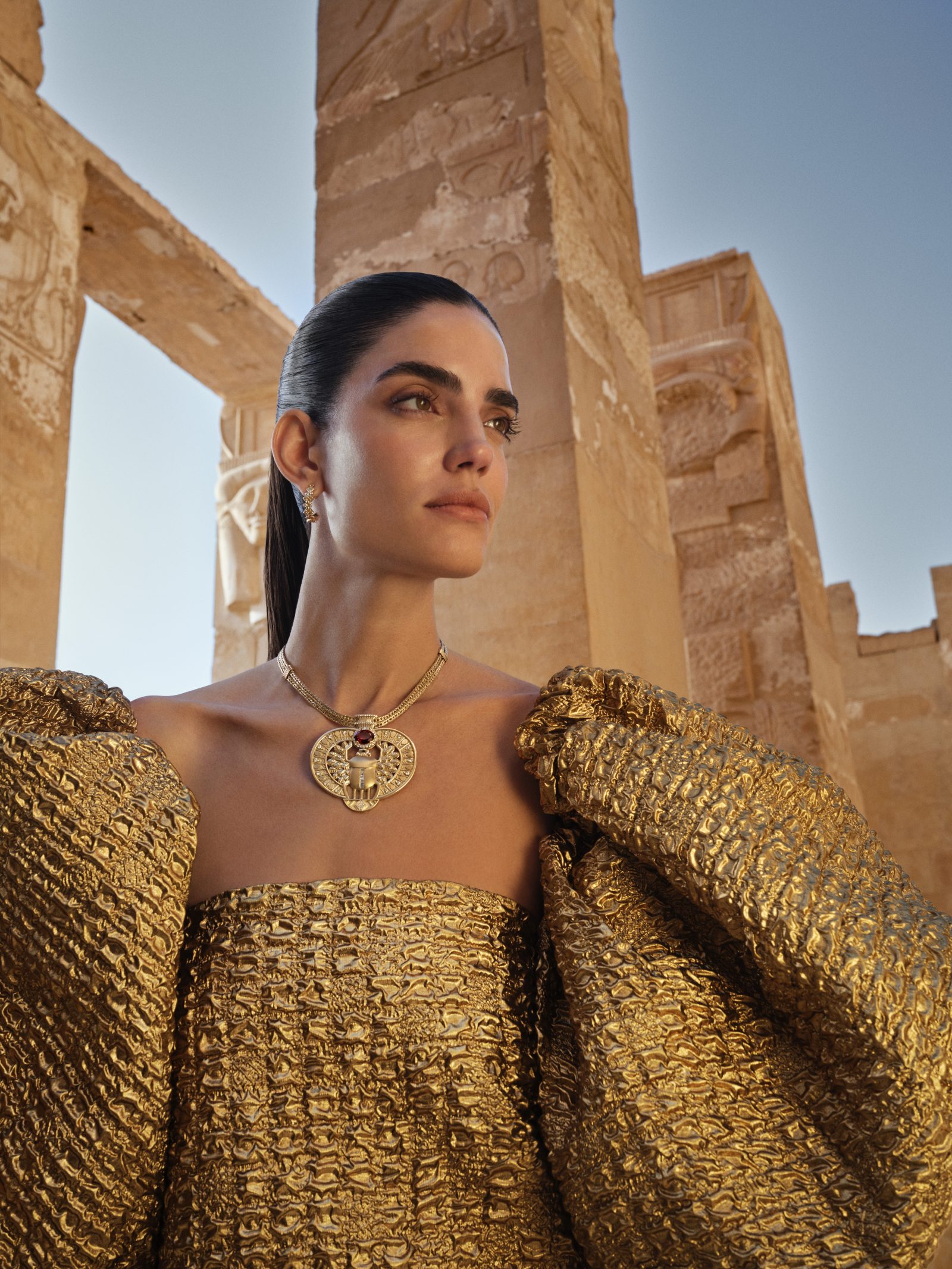

With extraordinary emeralds, sculptural goldwork and a fresh chapter of Tales of the Nile, the Egyptian jewellery house makes another compelling case for high jewellery with cultural intelligence.
Azza Fahmy has always understood something that much of the jewellery world is still trying to articulate: a jewel becomes considerably more interesting when its beauty has something to say.
There are diamonds, of course. Magnificent emeralds, richly coloured rubellites and morganites that would command attention in any high jewellery salon. But what continues to distinguish the Egyptian house is its ability to make these stones participants in a much larger story, one shaped by the Nile, ancient Egyptian iconography, Arabic poetry and the extraordinary vocabulary of regional craftsmanship.
With the latest additions to Tales of the Nile, Azza Fahmy Jewellery returns to this familiar territory with renewed ambition. Under the creative direction of Head Designer Amina Ghali, four new one-of-a-kind pieces join an evolving collection that treats the past as a source of creative intelligence rather than a catalogue of historical motifs.
And once again, the results remind us why Azza Fahmy occupies such an interesting position in contemporary high jewellery.
The Diamond Snake Necklace is perhaps the most immediate statement among the new creations. Crafted in 18-karat gold and designed around more than 20 carats of diamonds, it interprets the serpent as a symbol of transformation, renewal and protection.
The stones vary in size and form, giving the composition an individuality that feels particularly appropriate to the subject. A sculpted, diamond-encrusted snake head serves as the clasp, a detail that demonstrates how the house approaches jewellery as an object to be experienced from every angle.
The serpent is hardly unfamiliar to high jewellery. From the historic snake jewels of European maisons to the protective symbolism of ancient Egypt, it has occupied a privileged position in the jeweller’s imagination for centuries. The challenge is finding something meaningful to contribute to a motif that has already enjoyed so many interpretations.
Here, the interest lies in the relationship between the diamonds and the sculptural form, and in the house’s decision to retain the snake’s symbolic associations rather than rely solely on its visual appeal.
The Ottoman Crescent & Star Earrings explore a different chapter of regional history. Inspired by the visual language of the nineteenth-century Ottoman Empire, the one-of-a-kind earrings are crafted in 18-karat gold and designed around more than 15.5 carats of pear-cut morganites.
Personally selected by Ghali for their cut and colour, the gemstones provide the starting point for a composition incorporating diamond-encrusted crescents and stars.
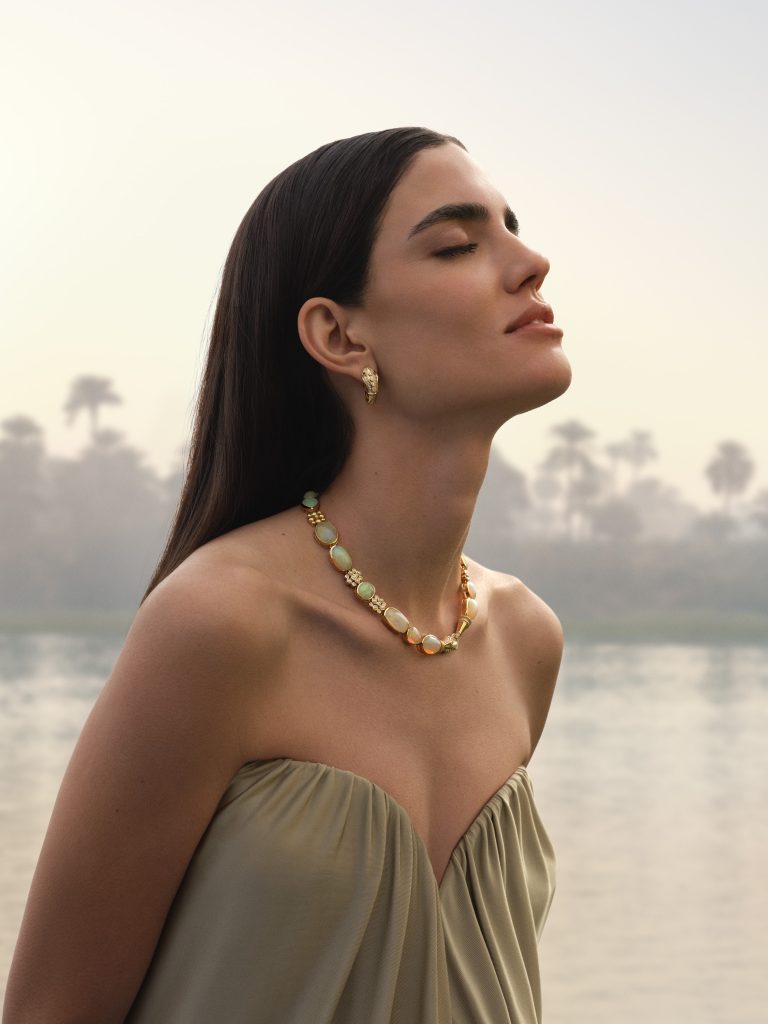
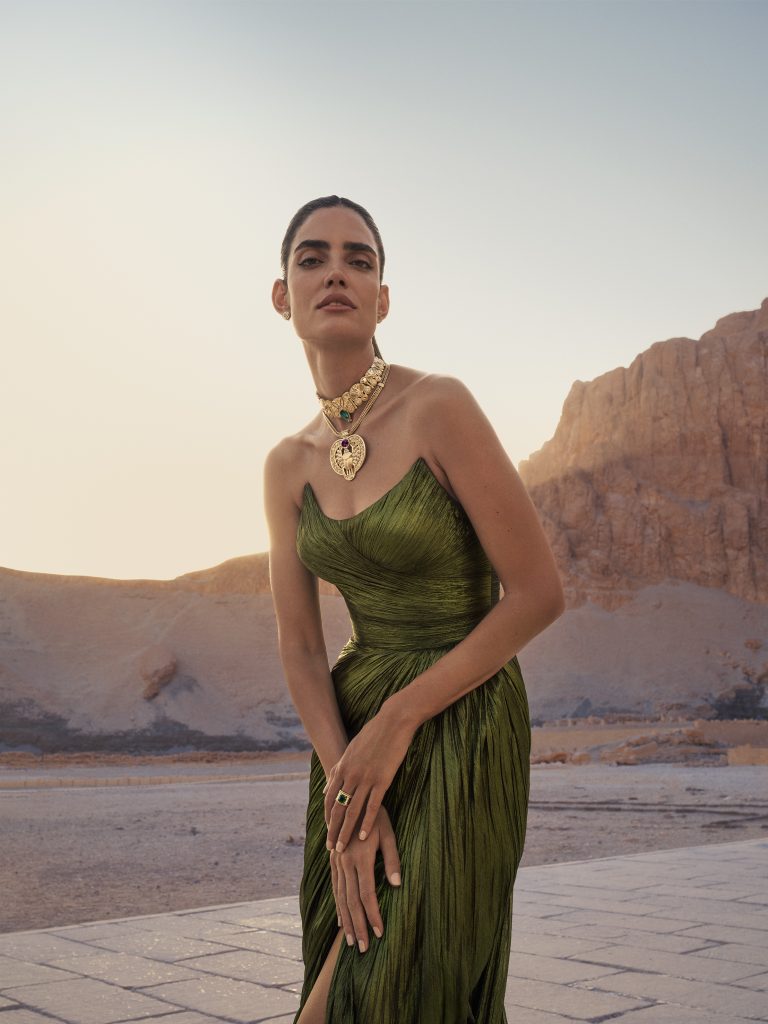
Image Source : Press Office
It is a thoughtful departure from the predominantly ancient Egyptian references that audiences may immediately associate with the house. The Ottoman influence acknowledges the broader historical exchanges that have shaped the region’s decorative arts and jewellery traditions.
And it makes an important point: Egyptian design heritage has never existed in isolation. Its history includes centuries of encounters with neighbouring cultures, shifting empires and evolving artistic traditions.
One of the more interesting aspects of Ghali’s approach is the degree to which individual gemstones influence the final design.
In traditional high jewellery, the relationship between a remarkable stone and its setting has always been central to the creative process. The finest examples achieve a balance in which the setting enhances the gem without reducing the jewel to a mere display of carat weight.
For Tales of the Nile, Ghali’s personal selection of stones, including gems sourced during her travels to India, gives this relationship particular importance.
The Eternal Bloom Earrings demonstrate that approach through 18.92 carats of cushion-cut and pear-cut morganites, accompanied by diamonds, sculpted flowers and the house’s signature filigree.
Their floral composition has a softness that contrasts with the more assertive symbolism of the serpent and the Ottoman crescent. Yet the intricacy of the goldwork provides the structural discipline necessary to keep the design from becoming overly decorative.
The Lotus Embrace Ring, meanwhile, centres on a 13.66-carat oval-cut morganite, surrounded by diamonds and held within an 18-karat gold composition inspired by the lotus.
The sculpted flower extends around the sides of the ring, creating a setting that appears to grow around the gemstone rather than simply hold it in place.
For anyone familiar with ancient Egyptian visual culture, the lotus carries associations with regeneration, life and the natural cycles of the Nile. Its significance extends well beyond its pleasing silhouette.
What makes the ring compelling is the translation of that symbolism into the physical architecture of the jewel. The flower is not simply applied as an ornament. It becomes part of the construction itself.
That distinction between decoration and design is where much of Azza Fahmy’s sophistication resides.
Although the four new pieces mark the latest reveal, two existing statement creations within the collection deserve particular attention for their relationship to ancient Egyptian royal iconography.
The Nile Lotus Choker centres on a 7.5-carat pear-cut emerald, selected for its vivid colour and depth, and set within an elaborate hand-carved 18-karat gold structure.
Inspired by Tutankhamun’s gold mask and royal nemes headdress, the choker incorporates diamond-encrusted lotus blossoms and daisies, geometric arrangements recalling Theban temple decoration, and delicate gold chains that descend into a tassel beneath the central stone.
The emerald is an inspired choice for a collection devoted to the Nile. Its green recalls the fertile landscape that developed along the river’s banks, a contrast to the surrounding desert that helped shape the civilisation’s relationship with nature, agriculture and renewal.
The Eternal Sun Necklace is equally ambitious in its symbolism.
At its centre sits a 6.88-carat oval-cut rubellite, positioned above a carved golden scarab and the basket-shaped nebsymbol. Together, these elements reference Neb-kheperu-ra, Tutankhamun’s throne name.
Wings of Horus extend around the scarab in a gesture of divine protection, while more than two carats of diamonds and the house’s signature double Roman chain complete the 18-karat gold necklace.
The combination of the scarab, solar imagery and hieroglyphic references requires more than an appreciation of ancient Egyptian aesthetics. It asks the designer to understand how symbols operated within a culture in which jewellery could express religious belief, political authority and protection.
This is where Azza Fahmy’s long engagement with historical research becomes especially relevant. The house’s strongest pieces do not depend on the novelty of borrowing an ancient image. Their strength lies in translating that image into something that can be worn today without entirely severing its relationship to the past.
Another characteristic that distinguishes Azza Fahmy is its longstanding relationship with written language.
Arabic calligraphy has become one of the house’s most recognisable signatures, bringing poetry, blessings and expressions of affection into the intimate space of personal adornment.
The Hand of Fatima Necklace incorporates a 4.60-carat cushion-cut emerald, intricate filigree and floral details, together with the protective invocation Ya Haris, meaning “Oh Protector.”
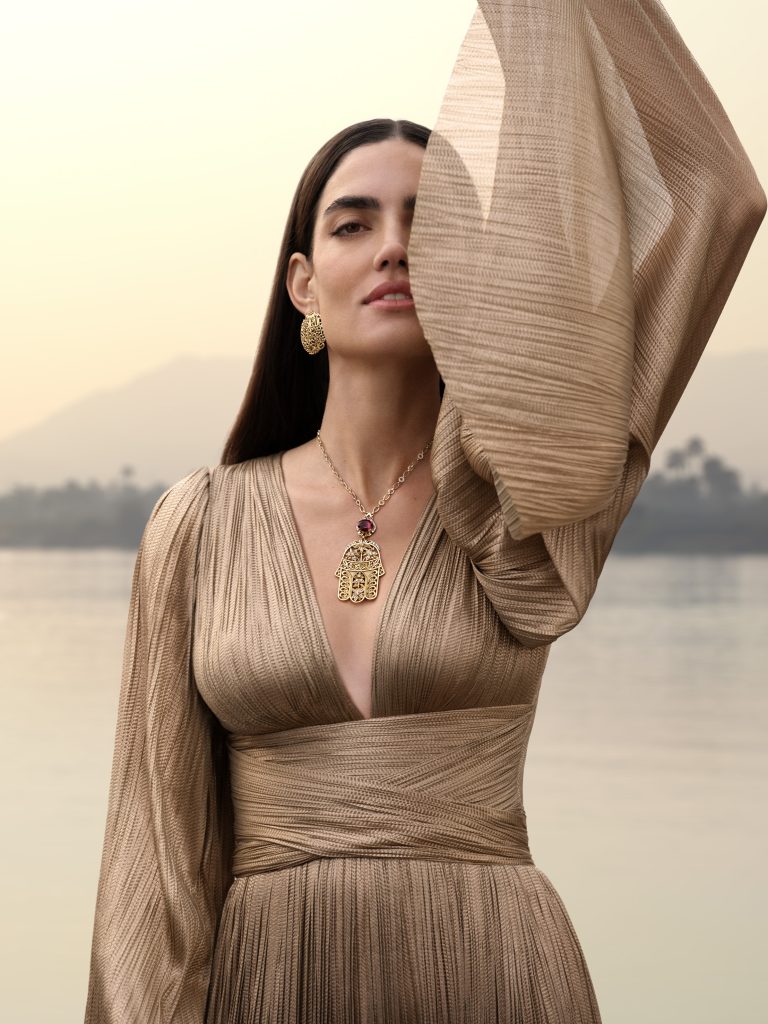
Image Source : Press office
The Tales of Love Necklace brings a 7.21-carat octagon-cut emerald into a composition of diamonds, handmade tassels and twisted wirework. Its inscription, “In my heart I see you every day and every night,” gives the jewel an emotional dimension beyond its considerable material value.
Then there is the Joy series, where rubellites become the principal source of colour and expression.
The Joy Necklace features 28.35 carats of oval-cut rubellites, pearls, filigree crescents and Arabic inscriptions celebrating happiness. The coordinating earrings contain 8.13 carats of oval-cut rubellites, while the Joy Bangle centres on a 6.57-carat cushion-cut rubellite framed by diamonds and surrounded by lace-like calligraphy.
What connects these pieces is their understanding of jewellery as something profoundly personal.
A necklace may be given to mark an occasion, inherited from a parent or worn as a reminder of someone absent. Words and symbols can deepen that relationship, transforming an ornament into an object with a particular emotional significance.

In Azza Fahmy’s work, this relationship is especially powerful because the language and cultural references are integral to the design, rather than added as an afterthought.
Founded in 1969, Azza Fahmy Jewellery has spent decades establishing a recognisable identity grounded in Egyptian and wider regional craftsmanship. The founder’s own journey began with an apprenticeship in Cairo’s historic Khan El Khalili jewellery quarter, where she learned the craft directly from master artisans before continuing her studies in London. That experience remains fundamental to the house’s philosophy, and its emphasis on preserving specialist skills.
Its evolution into high jewellery represents an interesting development in a sector historically dominated by European maisons, many of which built their reputations around exceptional gemstones, royal patronage and highly specialised workshops.
Azza Fahmy enters that conversation with a different inheritance.
Its design language draws on ancient Egyptian civilisation, Islamic and Ottoman decorative traditions, Arabic poetry and artisanal metalworking. These influences provide a cultural vocabulary that is both geographically specific and expansive enough to accommodate contemporary experimentation.
Under Amina Ghali, the house has continued to refine the relationship between this heritage and the demands of high jewellery, particularly through the selection of exceptional gemstones and the development of more ambitious sculptural compositions. The house’s own description of its creative process confirms the importance of allowing each stone’s natural form to guide the design.
The challenge for any jewellery house working so closely with history is to avoid becoming predictable. Familiar symbols can easily turn into signatures repeated without much further thought.
Tales of the Nile suggests that Azza Fahmy understands the difference between possessing a recognisable identity and simply reproducing it.
The four latest creations extend the collection in different directions, from the dramatic Diamond Snake Necklace to the softer floral compositions of the Eternal Bloom Earrings. The Ottoman Crescent & Star Earrings introduce another historical influence, while the Lotus Embrace Ring demonstrates how a familiar Egyptian symbol can become the structural foundation of a contemporary jewel.
There is confidence in that variety.
And there is something equally compelling about a jewellery house from the region telling these stories through its own creative perspective, rather than waiting for another luxury establishment to interpret them.
High jewellery will always be concerned with rarity. The quality of a gemstone, the precision of its cutting, the sophistication of its setting and the hours of work involved in its creation remain essential measures of excellence.
But rarity alone does not guarantee originality.
The most memorable jewels possess a sense of identity that survives beyond the initial spectacle of their materials. They offer something to discover in the details, in the references and in the relationship between the object and the person who wears it.
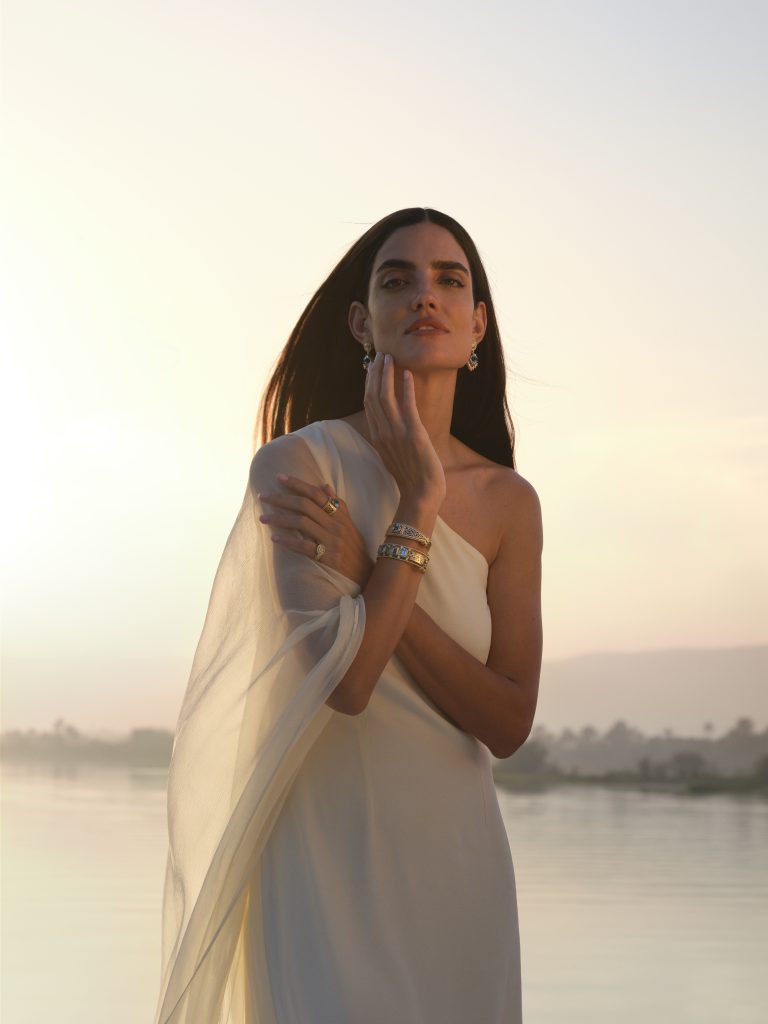
Image Source : Press Office
That is what Azza Fahmy continues to pursue.
With Tales of the Nile, the house makes another persuasive argument for high jewellery informed by cultural knowledge, craftsmanship and a willingness to interpret history with contemporary eyes.
The latest creations are being introduced to audiences at a jewellery fair in Doha, extending the collection’s story into another important cultural centre in the region.
And while the gemstones will undoubtedly command attention, it is the thinking behind them that gives these jewels their particular distinction.
Azza Fahmy does it again. Not by repeating a familiar formula, but by reminding us that the most enduring jewellery has something worth remembering.
What's Your Reaction?

