
Choose Your Armour: L’Atelier Nawbar and the Things We Carry Closest

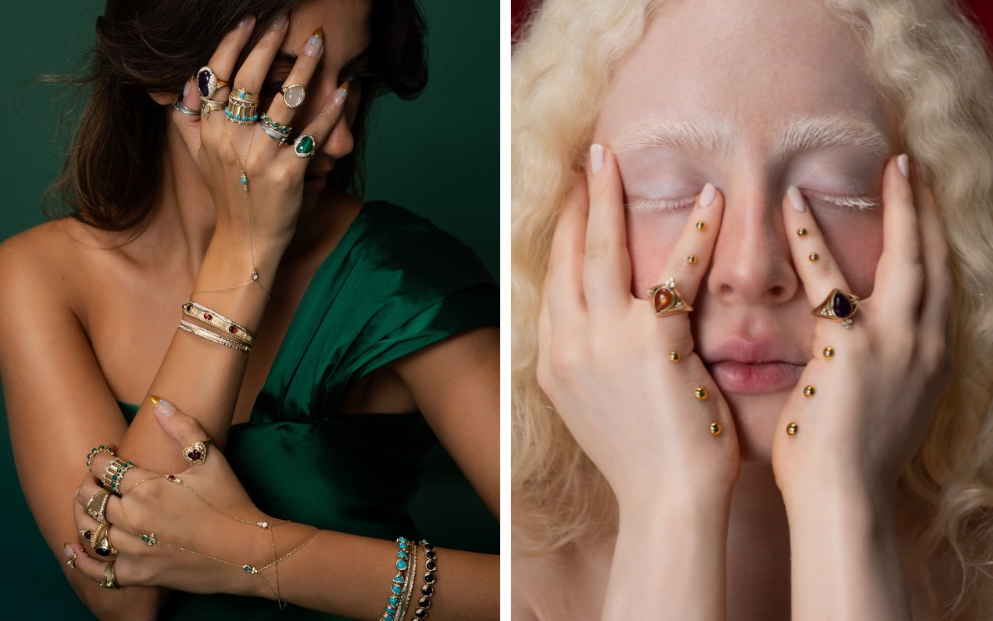

The Beirut jewellery house turns protection into a personal expression, exploring how the objects we wear can hold memory, affection and the quiet strength of belonging.
Jewellery has accompanied human beings through moments of celebration, mourning, departure and return for thousands of years. We have worn it to announce our place in society, to honour the people we love, to mark transitions and, perhaps most intimately, to protect ourselves from things we cannot always name. A ring inherited from a grandmother, a pendant given before a long journey, a bracelet that has remained on the wrist through years of change. Their material value may be considerable, but the attachment we develop to them often has very little to do with their price.
This understanding of jewellery as something deeply personal informs ARMOUR, the new fine jewellery collection from L’Atelier Nawbar, launching on 14 October. Conceived around the idea that everyone carries something worth protecting, the collection considers adornment as a form of emotional protection, giving physical expression to the people, places and memories that shape our lives.
It is a fitting proposition for a Lebanese jewellery house whose creative identity has long been informed by symbolism, craftsmanship and an unusually intimate relationship with the wearer.
At the helm are sisters Dima and Tania Nawbar, fourth-generation jewellers who have brought a distinctly contemporary perspective to a family legacy dating back to 1891. Their approach has never depended solely on the conventional codes of fine jewellery. Colour, humour, spirituality, nostalgia and personal storytelling have all found their way into the house’s collections, often through pieces designed to be worn every day rather than reserved for exceptional occasions.
With ARMOUR, that philosophy acquires another dimension. The jewellery becomes a means of carrying what matters, a personal reminder of the relationships and experiences that give us strength.
The collection’s central idea is deceptively simple. Everyone has something they wish to protect, whether a person, a memory, a place or a part of themselves. Rather than prescribing a single interpretation of strength, ARMOUR leaves that meaning to the wearer. A piece might represent a loved one, an important chapter in life or a private commitment that requires no explanation to anyone else.
This approach is particularly relevant to the way jewellery is experienced across cultures. Protective adornment has a long history in the Mediterranean, the Middle East and beyond, where symbols such as the eye, the hand and other talismanic forms have been associated with good fortune, spiritual reassurance and protection against harm.
L’Atelier Nawbar has explored this visual language for years. Its established repertoire includes the Kaff, a hand associated with promise, luck and protection; the eye, traditionally linked to warding off envy; and motifs such as the horseshoe, heart and sun, each carrying its own associations with love, vitality or good fortune.
These symbols form part of a broader cultural history in which jewellery communicates ideas that may be difficult to articulate through words alone. Their meanings can change between families, communities and individual wearers, which is precisely what gives symbolic adornment its enduring appeal.
ARMOUR extends this thinking by allowing protection to be understood in a more personal and contemporary sense. The collection does not suggest that jewellery can prevent life’s difficulties. Instead, it recognises the reassurance that can come from keeping a meaningful object close, particularly one associated with someone or something we value.
An object worn against the skin can become a private source of continuity, even as the circumstances around us change.
The collection also builds on the house’s signature approach to layering. Rather than treating a necklace, ring or bracelet as an isolated statement, L’Atelier Nawbar encourages the wearer to assemble pieces over time, allowing different combinations to reflect different aspects of their identity.
It is a design philosophy that has become closely associated with the Nawbar sisters. Their jewellery is intended to be accumulated, mixed and worn with a degree of freedom that challenges the formality traditionally associated with precious materials.
Within ARMOUR, this practice of layering becomes particularly meaningful. Each additional piece can represent another relationship, experience or memory, allowing the wearer to construct a personal arrangement that develops over time.
The result is an interpretation of armour that has little in common with the rigid protective structures from which the collection takes its name. Here, protection is expressed through intimacy and individuality, with jewellery functioning as a collection of personal associations rather than a uniform declaration of strength.
That idea also reflects a wider shift in how fine jewellery is understood. Increasingly, the appeal of a piece lies in the relationship between its design and the person who chooses to wear it. The value of precious materials remains important, as do craftsmanship and technical excellence, but personal meaning has become an equally compelling part of the conversation.
For L’Atelier Nawbar, this relationship is especially significant because the house has built its identity around making fine jewellery feel accessible to everyday life without diminishing the expertise required to produce it.
The sisters’ relationship with jewellery began long before they assumed responsibility for the family business. Raised around precious stones and the workshops of their father, Elie Nawbar, they inherited an understanding of jewellery rooted in both technical knowledge and personal experience. When they took over the business in 2010, they began reconsidering how that inheritance might speak to a generation whose relationship with luxury was becoming less formal.
Their response was to introduce a more playful design vocabulary, incorporating coloured enamel, hand-carved stones and pieces intended for layering. Equally important was their decision to make the process of jewellery production more visible, bringing the workshop into the experience of the Beirut boutique and allowing clients to witness the skills behind the finished objects.
In a May 2026 interview with The National, Dima described jewellery as an extension of the self, recalling the emotional importance of pieces acquired at different moments in life, whether inherited, purchased with a first salary or associated with the end of a relationship. It is an observation that helps explain the thinking behind ARMOUR. The most meaningful pieces are often those that have become inseparable from our personal histories.
That sense of attachment is supported by a commitment to craftsmanship that remains closely connected to Beirut. The house continues to work with Lebanese artisans, preserving techniques developed across generations while adapting them to contemporary forms. At a time when the transmission of specialist skills faces increasing pressures, the decision to maintain these relationships is both a creative and a cultural commitment.
A piece of jewellery can preserve more than the memory of its owner. It can also carry the knowledge of the hands that made it.
This connection between making and memory is especially relevant to a collection concerned with protection. For a family business spanning four generations, the preservation of craft is itself a form of safeguarding, ensuring that expertise inherited from the past remains part of the present.
There is also a distinctly Lebanese dimension to this story, although it deserves to be understood with some care. Lebanon’s jewellery and decorative arts traditions have developed through centuries of cultural exchange, commerce and skilled artisanal production. Beirut, in particular, has long served as a meeting point for different creative influences, contributing to a design culture comfortable with contrasts between heritage and experimentation.
For the Nawbar sisters, maintaining their production in Lebanon has remained important despite the economic and political instability affecting the country. Their commitment to local workshops reflects a belief that craftsmanship is inseparable from the people and communities responsible for sustaining it.
Against this background, ARMOUR’s language of memory, protection and belonging acquires additional resonance. The collection is not presented as a response to Lebanon’s circumstances, and it would be reductive to interpret every creation from the region through conflict. Nevertheless, the idea of carrying a place or a cherished memory close to oneself has particular relevance in societies where migration, displacement and the preservation of family histories have shaped personal experiences across generations.
Jewellery can offer a tangible connection to belonging, especially when the places and people that define us are no longer immediately within reach.
This is one reason symbolic jewellery continues to resonate across different generations. Its significance does not depend entirely on changing tastes. A pendant can acquire new meaning as it passes from one person to another, while a ring chosen for its appearance may eventually become associated with an important period in someone’s life.
The Nawbar sisters have built a contemporary jewellery language around this capacity for objects to accumulate meaning.
Their collections frequently draw from cultural symbols, celestial imagery, nature and personal relationships, but the interpretation is rarely confined to a single narrative. The wearer is invited to participate in the process, selecting pieces according to their own associations and arranging them in combinations that feel individual.
With ARMOUR, this freedom becomes central to the collection’s identity. The wearer decides what deserves protection, what should be remembered and which pieces become part of that personal story.
It is also an interesting proposition within the wider luxury industry, where exclusivity has traditionally been expressed through rarity, material value and recognisable design signatures. L’Atelier Nawbar approaches individuality through a different relationship with the customer, allowing the same piece to hold different meanings depending on who wears it.
This does not diminish the importance of design. Rather, it places greater responsibility on the designer to create objects that can accommodate personal interpretation without losing their own character.
The collection’s emphasis on stacking and layering supports that approach, allowing jewellery to evolve alongside the wearer instead of remaining fixed in a single composition.
As L’Atelier Nawbar continues to expand its international presence through retailers including Harrods, Bloomingdale’s UAE and NET-A-PORTER, its identity remains closely associated with the particular sensibility developed by Dima and Tania. Their work demonstrates how a family jewellery business can retain its cultural foundations while speaking to an international audience whose experiences and interpretations may differ considerably.
ARMOUR will be available from 14 October through the house’s flagship store, selected international retailers and lateliernawbar.com.
What makes the collection worth considering is the question it places at the centre of adornment: what do we choose to keep close, and why?
The answer will be different for everyone. For some, jewellery may represent love or family. For others, it may mark independence, remembrance, resilience or a personal achievement. Its meaning may change with time, acquiring associations that could never have been anticipated when the piece was first chosen.
Perhaps that is the enduring appeal of jewellery designed around personal symbolism. It allows an object of extraordinary craftsmanship to become part of an ordinary day, worn through the experiences that gradually give it significance.
With ARMOUR, L’Atelier Nawbar invites us to consider protection through the things we value most, allowing each wearer to decide what that means.
And sometimes, the most personal form of armour is simply a reminder of what we carry within us.
What's Your Reaction?

